
Processing: Emotions as Data
What do emotions feel like? What do they look like?
Where do they come from and what changes them?
How can I translate this information into an object?
These questions are the concept for a body of work that lives at the intersection of art and yoga. My inspiration is teaching with the intention to bring feelings to the surface. I am drawing attention to what’s going on inside, as a means of self-advocacy and self-care amidst the swirl of busyness, cultural norms, and overwhelm of daily life. A transdisciplinary approach allows me to explore the subject of emotions in art and science with the soft data of personal experience which is “nuanced, fuzzy, qualitative, expressive” (Lin, 2019).
I begin with journaling. Reflecting on my day, I write down key moments when I experience strong emotions (physical sensations), thoughts, and feelings (the way I categorize and hold onto emotions). I note as many details as I can remember including sensory information. Then I draw a line to describe the energy of the emotion, the quality of the thought or feeling, the direction of that part of my day. Last, I connect the line segments to reveal one day’s transition of emotions; after a week I can see frequencies and patterns.
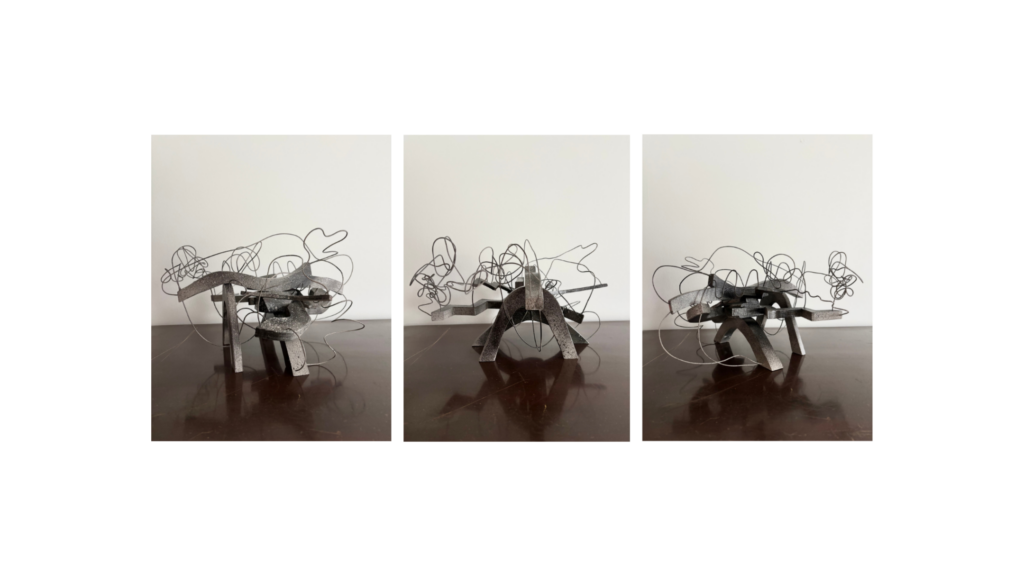
My first artwork in this series is a sculpture made of wood and wire, giving substance to the soft data. The wood is heavy and stable to represent consistency; the wire is thin and flexible, showing movement and change. All lines connect, as all feelings merge. The color is neutral, a gradient of black and gray with little dots throughout, to blur boundaries and emphasize the interconnectedness of feeling.
Using the creative process to understand the way I process emotion, reveals a relationship to material, object, and environment. “What new materialism brings to the art education table, then, is recognition that objects as materials have agency and affect us and that the intra-actions are what we must take account of (and sometimes do)” (Garber, 2019, p.12). I realize that emotions, feelings, experiences, and objects interact. As I sanded wood, bent wire, and sprayed paint, the texture of the materials softened my thoughts. Working with my data cleared my mind and made things feel easier.
Now I’m curious about sensory experiences that affect my body’s emotional processing, objects that alter my feelings, and how the context of emotion forms my experience. Continuing to find ways to care for myself, I am collecting the sounds, smells, and textures of things I enjoy to make new objects that can change the direction of my day. I am currently using coffee — painting to capture the smell, and printing on clay to see and touch the texture. This aligns with a concept in yoga, Pratipaksha Bhavana, which teaches, “when presented with disquieting thoughts or feelings, cultivate an opposite, elevated attitude” (Devi, 2007, p. 171). Art, as object and experience, creates change, giving form to an inner transformation.
References
Devi, N. J. (2007).The secret power of yoga: A woman’s guide to the heart and spirit of the yoga sutras. Three Rivers Press.
Garber, E. (2019). Objects and new materialisms: A journey across making and living with objects. Studies in Art Education, 60(1), 7–21. https://doi.org/10.1080/00393541.2018.1557454
Lin, Y. (2019). Resilience journal. Yo-yo lin. https://www.yoyolin.com/resiliencejournal